10,000 followers, not a single sale – why that's normal
What the numbers say about how art is bought, why likes tell you nothing about intent to buy – and where sales actually come from
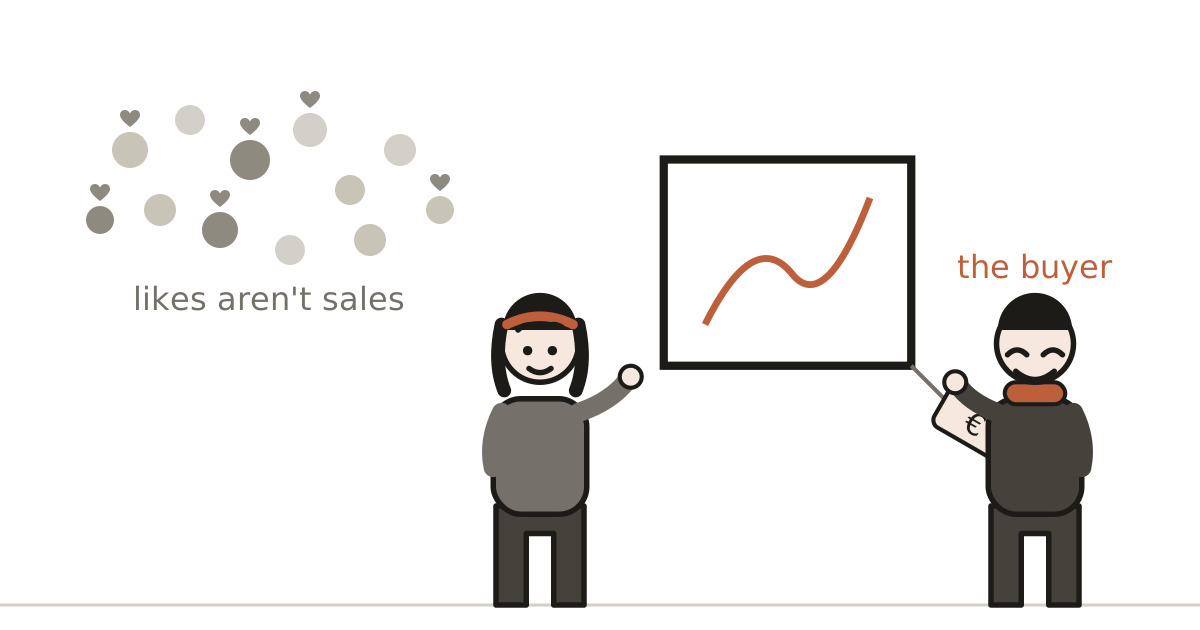
"I have a thousand followers and I've never sold anything." – "The reach is fine, the sales are zero." – "Only other artists follow me – nobody who'd actually buy art." After the reach frustration, this is the second most common thing I read in art communities. Usually with the same undertone: I must be doing something wrong.
Probably not. The link between audience and sales is far weaker than it feels – and that can be shown.
The dull numbers
One important caveat first: the most reliable data on art buying comes from the upper end of the market – from the Art Basel & UBS Global Art Market Report 2026 and the accompanying collector survey of 3,100 high-net-worth collectors across ten markets. For the range most of us sell in – small originals, prints, commissions – no comparably clean figures exist. I'm still drawing general conclusions from it, because the patterns match what artists and collectors describe in forums. If you don't want to follow that step, that's a fair objection.
The numbers for 2025:
- An average art dealer sold to 57 different buyers – over the entire year.
- For the smallest dealers (turnover below $250,000), it was 29.
- 49% of all buyers were new to that dealer's business.
- 51% of collectors who bought from dealers had made at least one purchase via Instagram without seeing the work in person.
- 43% bought directly from a studio, 37% commissioned works, 35% bought via Instagram links.
- 20% of the money surveyed collectors spent on art went directly to artists – the second-largest share after buying through dealers.
- 58% made purchases connected to an art fair.
- Purely online sales accounted for only 15% of the art market.
Three things follow from this.
First: selling art is a small-numbers business. We're talking about professionals with a gallery, a fair booth and an address book built over years – and still about two or three dozen people a year. If 10,000 followers don't turn into sales, that isn't an anomaly. One point belongs here, and it isn't in your favour: these dealers earn many times more per sale than a print or a small original brings in. 29 buyers sustain a business there – you'd need correspondingly more to live on it. What the comparison does show: even in the professional art trade, the number of people who actually buy is tiny compared to any reach figure. The error lies in expecting reach and sales to sit on the same scale. They don't – not remotely. And since even professionals have to find nearly half their buyers anew each year, almost nobody has a stock of customers who simply keep buying.
Second: Instagram is a sales channel – but through the direct line. Collectors really do buy there, even without having seen the work. What matters is the route: messages, links to your own shop, studio visits and commission enquiries – not a spontaneous purchase while scrolling past. At best, the feed provides the first contact. The decision is made in the conversation that follows.
Third: direct selling by artists is growing. A fifth of the money now goes straight to artists – galleries and intermediaries left out. That's the genuinely good news in these figures: the path from you to a buyer is as short as it has ever been. It just doesn't run directly through your follower count.
Your audience consists mostly of colleagues
The second reason is less comfortable: anyone posting art on social media primarily gathers other artists. The feeds are built that way – like to like. An artist put it this way on Bluesky: to sell, you need an audience that doesn't make art itself – and that's exactly what he was missing.
Likes from colleagues are real recognition, and they're valuable. But they measure craft, not intent to buy. People who draw rarely buy drawings – for the same reason chefs rarely order takeaway.
On top of that, the rule of thumb from community research (Nielsen, "90-9-1"): around 90% of people in an online community only read along. So most of your followers never react visibly, however good a work is. Likes don't show you how many people are following your work – and a purchase enquiry may well come from someone you'd never heard a peep from. An artist on Bluesky described exactly this pattern: her best sales were the works that had drawn barely any attention online.
What you can do with this
-
Count people, not followers.
Set a goal like "twelve buyers this year" instead of "5,000 followers." That's the order of magnitude professional dealers work in – and it's a goal you can actually influence.
-
Make the route to purchase visible and frictionless.
The most common frustration on the buyer's side isn't the price, it's the hassle: no price given, no dimensions, no reply to messages, unclear shipping costs. One collector described buying from an independent artist simply as "a complete mess." Anyone who wants to buy should know in two steps: what does it cost, is it still available, how does it reach me?
-
Give the work a context that opens a conversation.
The strongest recurring advice from people who have sold art for decades: what sells is meaning – where the motif came from, what was difficult about it, what you were looking for. The image alone can't do that, because online it sits beside a thousand other good images.
-
Build an entry level.
People who don't know you yet rarely buy the most expensive piece first. Smaller formats, studies and prints are the usual bridge – without discounting your originals to get there.
-
Deliberately seek the places where people interested in art are – not only artists.
Markets and local exhibitions, communities around your subjects, the circles around your existing buyers. Both groups mix there, and the hit rate is higher than in a feed whose recommendation logic reliably sends you to colleagues.
Finally
The gap between your follower count and your sales isn't a sign that nobody wants your work. It's a sign that the two numbers measure different things: one measures how well you perform in the feed. The other measures how many people found the way from the image to a conversation – and that path is short, if you build it.
I write this as someone currently working on a platform for artists, and running into the same point over and over: almost everything in the online art world is designed to display images – almost nothing to turn interest into a conversation. If you feel like it, tell me how your sales came about. Those routes are exactly what I'm collecting right now.
Sources
- The Art Basel & UBS Global Art Market Report 2026 (Arts Economics / Dr Clare McAndrew, published 12 March 2026; 2025 figures: avg. 57 buyers per dealer, 29 for dealers below $250,000 turnover, 49% new buyers, online-only sales share 15%) – primary (publishers' press release): artbasel.com
- The Art Basel & UBS Survey of Global Collecting 2025 (Arts Economics; survey of 3,100 high-net-worth collectors in 10 markets; 51% Instagram purchase without viewing, 43% studio purchases, 37% commissions, 35% Instagram links, 20% of spending direct to artists, 58% fair-related purchases) – primary (analysis on Art Basel's report site): theartmarket.artbasel.com
- Jakob Nielsen, "Participation Inequality" (90-9-1) – primary: nngroup.com
- Collector and artist voices from r/artcollecting and r/ArtBusiness (communication problems in direct sales, "the story sells, not the image") – primary, threads read directly; documented in our own 12-month Reddit analysis
- Observations from our own monitoring radars (Bluesky, Instagram, Threads, Tumblr; July 2026: "no non-artist audience", "best sales = works with little attention", "followers but no customers") – primary, own observation