Your reach collapsed – and it's not your art
What actually changed on Instagram, X and the rest, what part of it is documented – and what genuinely helps now
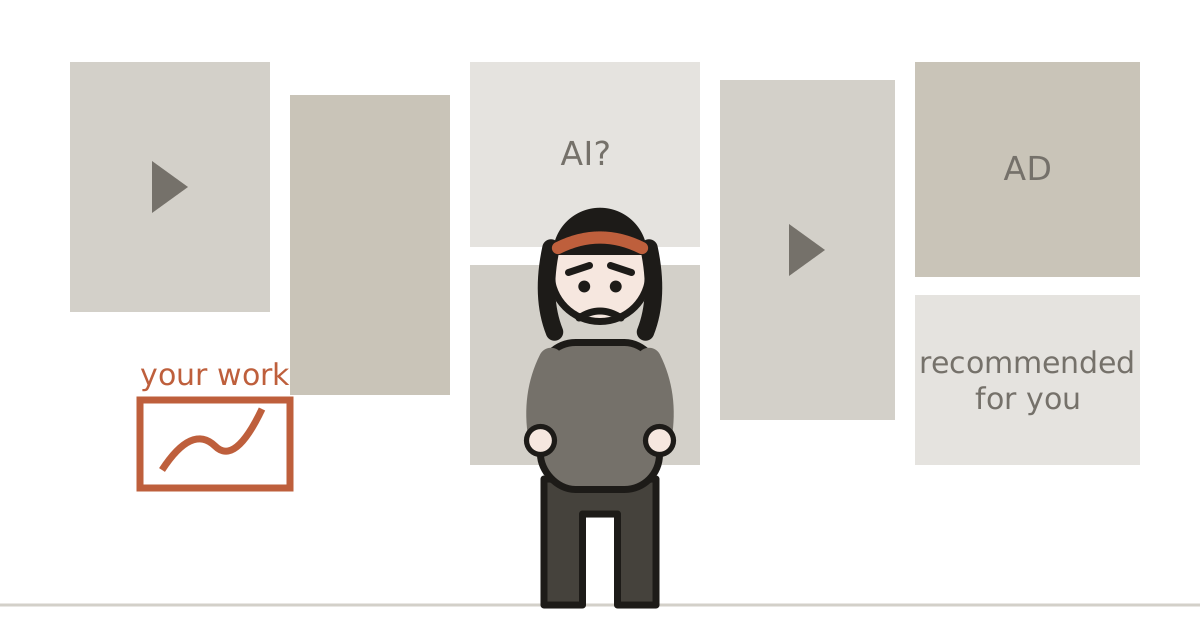
"Barely anyone sees what I post." – "What's even the point of posting anymore?" – "I'm screaming into the void." I read sentences like these every day, on X, on Threads, on Bluesky, in the art subreddits. And almost always the same thought follows: maybe my art just isn't good enough.
That conclusion is understandable – and it's wrong. By now I can actually show why.
What's documented
The numbers for image posts are bad – and getting worse. For its Instagram benchmark, Socialinsider analysed 35 million posts from 447,613 profiles. The average engagement rate in 2025 was 0.48 %, down 24 % year over year. Static images took the hardest hit: down 17 % year over year, and only 0.33 % in the second quarter of 2026. That's precisely the format most visual art lives in.
New accounts grow at half the old rate. In the same dataset, annual follower growth for small profiles (1,000–5,000 followers) – how many new followers they gain relative to the ones they already have – fell from 38 % to 22 %.
There is less and less room in the feed for the accounts people actually follow. You don't have to guess at this; it's stated openly on the quarterly earnings calls. Mark Zuckerberg, April 2024: "For the first time ever, more than 50 % of the content people see on Instagram is now AI recommended." For Facebook he named 30 % – "up 2x over the last couple of years." Put differently: the feed consists mostly of suggestions from accounts you don't follow. Whatever space goes to strangers is space taken from the people who chose to follow you.
And your work now has a shelf life. On Meta's earnings call of 30 July 2026, CFO Susan Li reported that every public Feed and Reels post now runs through a large language model that analyses everything from topic to tone and feeds those signals into the ranking system. A second figure from the same call says even more about an artist's daily reality: more than half of all recommended Feed content on Instagram is now less than a day old – double the level of a year earlier. A picture you spent three weeks on therefore has a window of a few hours before it counts as "old." On the same call, Zuckerberg announced a third source of content: a "nearly infinite" stream of AI-generated, personalised material.
And browsing someone's body of work has become harder. In May 2026, X replaced the "Media" tab on mobile profiles with a "Videos"-only tab. Anyone wanting to look through an artist's images suddenly found nothing but video clips. One change by the platform operators – and an artist's works are no longer findable.
To be clear: none of these figures refer specifically to artist accounts. Benchmark studies analyse brand accounts and engagement rate is not the same thing as reach. There is no clean long-term study of art accounts. What there is are three independent strands: industry data, the operators' own statements and verifiable product changes. All three point the same way.
It isn't you – the maths was changed
A follower used to work a bit like a subscription: you post, your people see it. Today a follower is a hint to a recommendation system – a suggestion, not a promise. That isn't malice, it's a business model: time spent sells advertising and content from strangers demonstrably holds attention longer than content from people you know.
What I do hold against the operators isn't the rebuild. It's the story told around it. While distribution is being reorganised from the ground up, artists keep hearing advice about "quality," "consistency" and "authentic storytelling" – as if the collapse were a personal failing. The operators change the rules and hand the blame back to the people following them. That's the real damage: thousands of people convinced their work is worthless because a metric fell that they never controlled.
What genuinely helps now
-
Change the metric before it wears you down.
Reach is the one number that isn't yours. Count what indicates closeness instead: saves, shares, DMs, newsletter sign-ups, names that keep showing up under your posts. Ten people who forward your work to someone are worth more than 3,000 anonymous impressions – and they're the only part of the statistics no update can halve overnight.
-
Give your works a permanent home.
Your pieces need an address where they sit in order, permanently and findable – whether that's a site of your own or a platform where each work keeps its place instead of drifting past in a feed matters less. Three conditions matter more: your works are still reachable months later, you can export and take them with you at any time, and the link to them stays stable. Feeds are feeder channels, not archives – the X media tab just demonstrated how quickly someone else's archive can become unreachable.
-
Set up a direct channel, however small.
An email list is unglamorous and the only route to your audience that nobody can rebuild. 200 addresses belonging to people who want to read you are more stable than 5,000 followers who may or may not be shown your work. The best time to start was three years ago; the second best is today.
-
Count on the quiet ones.
The rule of thumb from community research (Nielsen, "90-9-1") still holds: around 90 % of people in an online community only read along, about 9 % react occasionally, 1 % produces most of the content. More recent research treats that reading-along not as passivity but as a full form of participation. So your numbers never show you your audience – only the small, loud part of it. Collectors say as much themselves: in the end, buying happens through DMs, email and conversation, not through the like button.
-
Don't post more – post with more context.
The reflexive escape route – post more often, video instead of images, chase every trend – leads exactly where 52 to 78 % of creators already are: burnout, with creative exhaustion as the main cause. What demonstrably works is the opposite of volume: the story behind the work, the process, the decision, the failed attempt. People attach themselves to context, not to frequency. And when in doubt: a work seen by only 40 people still came into existence. The feed is not the place where the worth of your work is decided.
Finally
The collapse you're experiencing is real, it's documented and it's the result of decisions made by other people – in rooms where nobody ever saw your work. That's the bad news. The good news: everything that helps now leads away from a number that was never yours, and towards something that lasts – a place of your own, a direct line, a handful of people who really look.
I'm not writing this from a neutral position. I'm building a platform for artists at the moment, because I believe the infrastructure art lives in online was never built for works, but for time spent. If you feel like it, tell me how this looks from where you sit – I'm collecting exactly these experiences right now.
Sources
- Socialinsider, "2026 Instagram Organic Engagement Benchmarks" (vendor study, own data collection: 35m posts, 447,613 profiles, Jan–Dec 2025; Q2 2026 update) – primary for its own data, vendor study: socialinsider.io
- Mark Zuckerberg, Meta Q1 2024 earnings call, 24 April 2024 ("more than 50% of the content people see on Instagram is now AI recommended") – primary statement, secondary evidence via Benzinga: benzinga.com
- Meta Q2 2026 earnings call, 30 July 2026 (Susan Li on LLM processing of all public Feed/Reels posts; "more than half of recommended content less than one day old"; Zuckerberg on the "nearly infinite" AI content feed) – primary statements, secondary evidence via Benzinga: benzinga.com
- X replaces the media tab, May 2026 (report with user evidence and screenshots) – secondary, with linked primary evidence: piunikaweb.com
- Jakob Nielsen, "Participation Inequality" (90-9-1) – primary: nngroup.com
- Creator burnout (52–78 %, creative exhaustion as main cause) – primary (industry study) / accompanying research: billiondollarboy.com · journals.sagepub.com
- Practical recommendation on email lists for artists – secondary (trade blog): artworkarchive.com
- Sentiment from our own monitoring radars (X, Threads, Bluesky, Tumblr, Instagram, Reddit; July 2026) – primary, own observation